Search This Blog

Tuesday, November 24, 2015

Emmanuel: Reflections on the Incarnation of Jesus Christ


God with us. That’s what Emmanuel means… and it was one of the most important names given to Jesus Christ upon His arrival into humanity.


And as always when God gives a name it has a great meaning.


Isa 7:14 "Therefore the Lord Himself will give you a sign: Behold, the virgin shall conceive and bear a Son, and shall call His name Immanuel.

Mat 1:23 "Behold, the virgin shall be with child, and bear a Son, and they shall call His name Immanuel,"  which is translated,  "God with us."

"Adoration of the Shepherds" by Gerard van Honthorst, 1622


The word “incarnation” , which we used above , literally means  “in the flesh”.

Many times I’ve tried to think of something analogous to God becoming a man – but every analogy seems to fail.  A man to a dog?  A start but not even close.

C.S. Lewis said this of  trying to comprehend the Incarnation…

"For certainly no seed ever fell from so fair a tree into so dark and cold a soil as would furnish more than a faint analogy to this huge descent and re-ascension in which God dredged the salt and oozy bottom of Creation."

For we know for certain that a man named Jesus existed. Although  the four Gospels contain most of what we know about Jesus and what he did and said – and we know that these have been proven historically reliable -  Jesus is also mentioned in secular works and there is really no legitimate debate in any circle as to whether He lived.

There is neither a question, if you read the Gospels, that He claimed to be the Son of God.  And I suppose this is where some folks get hung up …

A Virgin birth?
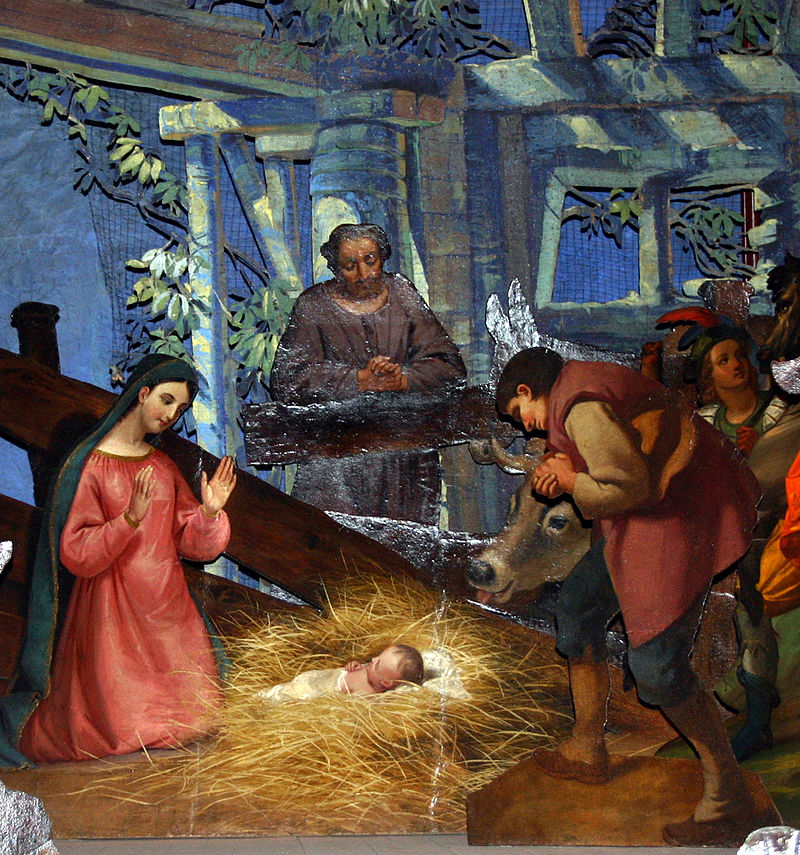

Paper on wood Nativity scene from 1750, Milan, presenting a tender image of Jesus.


At this point you may be scoffing or simply doubting the science of it all. For the latter – fair enough. But all that is needed for this to be a real possibility is the belief in the miraculous.

 If the miraculous can happen, then this could have happened.

Of course many claim the miraculous, and I do not intend to go into the apologetics of this specific miracle – but we must always ask ourselves “What becomes of said miracle?”  Does it flash in the pan and then die out ? Does it ever really affect the real world? Do the preceding, surrounding and proceeding events of the miracle ever lend credibility to its claim?

As for me, I believe Jesus when He said he was the Son of God and that is why I am thrilled to meditate on this idea of my God becoming a man – retaining His almighty power and purity – but inhabiting and experiencing humanity first hand.

Emmanuel – o how sweet that sound. God with us.


This year my wife and I were blessed with a child and I watched that child grow in the womb and eventually burst into this world.  It was violent and messy and more beautiful than I could have imagined.

And now I think – God did this? He subjected Himself to this?


From a zygote to an embryo to a fetus to a baby to a child to a teenager to a man – Jesus was all of these things or rather, all of these stages of humanity.

"What Child is this?"  The hymnist cried.


"The divine Son became a Jew; the Almighty appeared on earth as a helpless human baby, unable to do more than lie and stare and wriggle and make noises, needed to be fed and changed and taught to talk like any other child... The more you think about it, the more staggering it gets."

J. I. Packer


Hbr 2:17 Therefore, it was necessary for him to be made in every respect like us, his brothers and sisters,  so that he could be our merciful and faithful High Priest before God. Then he could offer a sacrifice (Propitiation) that would take away the sins of the people.

Hbr 2:18 Since he himself has gone through suffering and testing, he is able to help us when we are being tested.    NLT

 ------


Hbr 4:15 For we do not have a High Priest who cannot sympathize with our weaknesses, but was in all points tempted as we are, yet without sin.

 Hbr 4:16 Let us therefore come boldly to the throne of grace, that we may obtain mercy and find grace to help in time of need.   NKJV

Notice the phrases “in every respect” and “in all points tempted as we are, yet without sin”.

Could it be?

God knows what it is like to feel the sting of temptation?  The trials of humanity?

Every temptation ?  Every trial?

He knows what it is like to be as helpless and dependent as an infant, to be obedient to earthly parents as a child, to struggle with all the confusion of adolescence?

He knows all the human hurts of love and the lack thereof?

The depth of pain at the loss of a loved one? ( John 11:35)

The stress and sometimes, dreariness, of the daily grind?

The physical weaknesses of exhaustion, hunger, poverty, homelessness and so on?

Without being mentally ill Himself,  He yet knows their suffering and feels their pain?

Without so much as a dirty or ungodly thought, He still knows all the struggles men and women have with their sexuality?

Even a cursory reading of the Gospels will tell you that indeed Jesus has felt the relentless cruelty of “the bully”…. Both in mockery and physical assault, to a degree we know nothing of.

Do we struggle with self-esteem and body image issues?

We often have that “anglicized” image of Jesus in our minds – the tall,  blonde, blue eyed version. But the Bible tells us that there is no special physical beauty to Him, He was very average in appearances.

It was what was inside that changed history…


Isa 53:2 For He shall grow up before Him as a tender plant, And as a root out of dry ground. He has no form or comeliness; And when we see Him, There is no beauty that we should desire Him

In Matthew  chapter 8, verses 23-27, we have the account of Jesus in one moment sleeping in the haul of a boat  and in the next commanding the wind and the waves to be calm.

Both weary and Almighty?   What Man is this?

Jesus in the Garden of Gethsemane before His betrayal and crucifixion


And we have not even spoken of the spiritual yet. Oh, the sorrow and pain He suffered in Gethsemane and then the cross – forsaken, bearing all the wrath against humanity’s sin. He knew this wrath was justified – but the sin was not His.

Every sentence ever handed down to any man, woman and child – and those to come – He took, He served, He paid.

He ransomed us.

And this is love.


The Incarnation takes singer
Joan Osborne’s query,
“What if God were one of us?”
 to a whole new level.


As one preacher put it…

“ The Incarnation is God’s Grace made evident and obvious.               People matter.  
                        Life is sacred.
Men, women and children are worth the greatest sacrifice, the Supreme Effort, the Ultimate Gift….”

And it is , of course, of the utmost importance to understand that although Jesus felt the sting of temptation and trial – He did not sin, not even once in thought or deed.

As Charles Spurgeon said “Jesus entered into all that men did except their sins.”

In understanding how God became a man, we must understand the theology of the Bible in saying that Jesus Christ was not 2 different people – one deity and one human – Jesus was indeed both fully God and fully man all at once.

Nor was His Deity diluted by His humanity – for Jesus bore the full  nature of both the Divine and the human in one Person… and according to the Bible, He still does to this day and will forever.


Theologians have simply put it this way:


Remaining what He was, He became what He was not.


"The glory of the incarnation is that it presents to our adoring gaze not a humanized God or a deified man, but a true God-man - one who is all that God is and at the same time all that man is: one on whose almighty arm we can rest, and to whose human sympathy we can appeal." Benjamin B. Warfield

Have you ever wondered what God is like?

What if He were one of us?

 Read about Jesus this Holiday season and find out  – that was the whole point of the Incarnation and it is the whole point of Christmas…


"....who being the brightness of His (God's)  glory and the express image of His person, and upholding all things by the word of His power, when He had by Himself purged our sins, sat down at the right hand of the Majesty on high.." Hebrews 1:3

(* The phrase "express image" is the Greek word Charakter from which we get "Character")


He is the image of the invisible God……
Col 1:15


May God richly bless you all.


----------------------------------------------

When God the Almighty was making mankind through His own Word, He perceived that they, owing to the limitation of their nature, could not of themselves have any knowledge of their Artificer, the Incorporeal and Uncreated. He took pity on them, therefore, and did not leave them destitute of the knowledge of Himself, lest their very existence should prove purposeless.

For of what use is existence to the creature if it cannot know its Maker? How could men be reasonable beings if they had no knowledge of the Word and Reason of the Father, through Whom they had received their being? They would be no better than the beasts, had they no knowledge save of earthly things; and why should God have made them at all, if He had not intended them to know Him? But, in fact, the good God has given them a share in His own Image, that is, in our Lord Jesus Christ, and has made even themselves after the same Image and Likeness.

Athanisius, 4th century scholar and early church father

Friday, October 31, 2014

What Is a Saint ( All Saint's Day)

What is a Saint?

Today is All Saint’s Day in the Roman Catholic Church ( put at that place on the calendar to counter disturbing pagan festivals). The RC Church has quite a list of criteria in order for someone to become canonized as a saint but really what is a Saint? According to the Bible, specifically the New Testament, a saint is simply a believer in Jesus.  We tend to think of a saint as someone who has a halo above their head and is as pure as the driven snow; however,  that’s not what the Bible describes.

The Greek word hagios is where we get “saint” from – it means Holy, separated unto God. The early Greeks used it of something separated unto the gods but the Christian term signifies something that is separated unto God not by man but by God Himself. Someone who is not holy in and of himself but made holy by God through faith in Jesus’ atoning death and resurrection. In the Bible it refers to both believers who have gone before us and those who are now with us on earth. The Bible also uses hagios to refer to Jesus Christ as the "Holy One" or "Saint" of God (Mark 1:24 , Acts 3:14, 1 John etc..).  

Easton’s Bible Dictionary tells us that “It was not used as a distinctive title of the apostles and evangelists and of a "spiritual nobility" till the fourth century. In that sense it is not a scriptural title.”

Vine further says “This sainthood is not an attainment, it is a state into which God in grace calls men ; yet believers are called to sanctify themselves …consistently with their calling.”

They are not a saint because they are holy; they are holy because they are a saint – and they are only a saint because they believed in Jesus and trusted Him to forgive their sins.

Methodist, John Wesley did not agree that saints of any kind should be venerated or prayed to but he did agree that there is much for us to learn from the saints ( all believers) who have gone before us. After all that's what Hebrews 11 is all about. 

So if I am to honour this holiday at all then it will be to be thankful that God, through Jesus, has made me, ever the sinner,  into a saint – not by my works but by His grace. I can also glorify God by thanking Him for the many godly examples of past believers and current mentors, friends, brothers and sisters whom I can call saints and who have blessed my life and my Christian faith. To me, that is what sainthood is all about.


“Now, therefore, you are no longer strangers and foreigners, but fellow citizens with the saints and members of the household of God…” Ephesians 2:19

Tuesday, September 30, 2014

Understanding the Gospel of Jesus Christ (Inspired by The Gospel Centered Life by World Harvest Mission [now Serge])

Even though I had been a Christian for three decades, when I went through this study material a few years ago something really clicked for me. I received a better understanding of the Gospel of Jesus Christ and how I (and each of us as human beings) relate to God in the context of the Gospel.

This blog is a bit of a summary of the first three lessons in this study by World Harvest Mission ( now Serge) intermingled with some of my own and others thoughts – for further study I would suggest purchasing this work and going through it yourself by yourself or with a group.  As always Scripture is the only foundation and key to understanding the Gospel.

First and foremost it is necessary to understand that the Gospel of Jesus Christ is good news. In fact, that is literally what gospel means in the Greek language – good news.

You have probably seen "John 3:16" on a sign at sporting events or on TV. So why is that particular Bible verse so popular? Basically because it sums the Gospel up in a very concise and meaningful way. Many call it "the Gospel in a nutshell".

“For God so loved the world that He gave His only begotten Son, that whoever believes in Him should not perish but have everlasting life." John 3:16


Vine defines the Gospel this way:  “In the New Testament it denotes the "good tidings" of the Kingdom of God and of salvation through Christ, to be received by faith, on the basis of His expiatory (reconciling) death, His burial, resurrection, and ascension, e.g., Act 15:7; Acts 20:24; 1 Peter 4:17.”

But for something to be good, it must be contrasted with what is bad. And so the Gospel is purely good news but is set against the backdrop of a broken world and individual human sin and rebellion against God. Let’s look at a few  verses in the Bible to understand this:

The backdrop of bad news
“The sin of Judah is written with a pen of iron;
With the point of a diamond it is engraved
On the tablet of their heart…” Jeremiah 17:1

The good news
“I will give you a new heart and put a new spirit within you; I will take the heart of stone out of your flesh and give you a heart of flesh.” Ezekiel 36:26

The backdrop of bad news
“For all have sinned and fall short of the glory of God.” Romans 3:23 or as the New Living Translation puts it “For everyone has sinned; we all fall short of God’s glorious standard.”

The good news
“For the wages of sin is death, but the gift of God is eternal life in Christ Jesus our Lord.”  Romans 6:23

As C.S. Lewis, the author of the Chronicles of Narnia, said, “It is the change from being confident about our own efforts to the state in which we despair of doing anything for ourselves and leave it to God.” 

It was a deeper understanding of this principle – that is my utter inability to earn God’s love and forgiveness - that led to an even deeper feeling of freedom for me and appreciation of God. Of course I continue to lose sight of this and must seek this understanding every day.

The Gospel Grid from the Gospel Centered Life,  World Harvest Mission (Serge) 

And that is where the Gospel Grid chart comes in. It takes this principles and helps us visualize it. Beginning at the moment of our very first understanding and belief in the Gospel we begin a journey into knowing more and more of God and the Cross.

As the writers of the Gospel Centered Life study put it:  Many Christians live with a truncated view of the gospel. We see the gospel as the “door,” the way in, the entrance point into God’s kingdom. But the gospel is so much more! It is not just the door, but the path we are to walk every day of the Christian life. It is not just the means of our salvation, but the means of our transformation. It is not simply deliverance from sin’s penalty, but release from sin’s power. The gospel is what makes us right with God (justification) and it is also what frees us to delight in God (sanctification). The gospel changes everything!”

As the chart indicates, the cross becomes more and more prominent (and understood) in our life as we do two things:

1)     Grow in the awareness of God’s holiness and purity

2)     Grow in the awareness of our flesh and sinfulness

At first this chart stirred up some old negative feelings of legalism in me. I thought to myself “Oh great, I need to take out the flagellum and whip my back in order to please God and subdue my flesh.” However, the Gospel teaches exactly the opposite – we can do nothing in our own efforts. God gives salvation freely and He gives freely the grace for us to grow more holy.

In understanding the difference between a negative legalistic view of God and of our selves (see Galatians) and a positive graceful view of God and of ourselves, I think it is important to look at Romans chapter 7.

Verses 14-19, 23-25

For we know that the law is spiritual, but I am carnal, sold under sin.
For what I am doing, I do not understand. For what I will to do, that I do not practice; but what I hate, that I do.
If, then, I do what I will not to do, I agree with the law that it is good.
But now, it is no longer I who do it, but sin that dwells in me.
For I know that in me (that is, in my flesh) nothing good dwells; for to will is present with me, but how to perform what is good I do not find.
For the good that I will to do, I do not do; but the evil I will not to do, that I practice…
…For I delight in the law of God according to the inward man.
But I see another law in my members(*of the human body or flesh) , warring against the law of my mind, and bringing me into captivity to the law of sin which is in my members.
O wretched man that I am! Who will deliver me from this body of death?
I thank God—through Jesus Christ our Lord! So then, with the mind I myself serve the law of God, but with the flesh the law of sin.

We see the here the inherent struggle of the Christian and, in general, that of the entire human race. The Human Condition as the philosophers call it.

But Paul, the author of Romans, sees the difference between the hopeless sinful flesh part of us and the beautiful image of God part of us.Its not a stretch to say that this basic principle is also indicative of all humanity.  

As one saintly old preacher put it, “ We are unworthy but we are not worthless.”

The only answer that Paul finds to this constant bitter struggle? The only thing that will deliver him? God, through Jesus Christ our Lord!


And so just as it is when we first become Christians ( “Saved” “Born Again” etc.) , so it is as we live each day of the Christian life victorious  – by 1) understanding and acknowledging our utter inability to satisfy God’s holiness or to earn our personal salvation and then by 2) placing all our faith, and hope in Jesus Christ and His Gospel. It’s not that we don’t seek or try – its that we understand that all our seeking and trying is useless if we do not have the grace of God and the Holy Spirit empowering them.

Wednesday, September 17, 2014

Finding ( A Poem)


Finding

She woke up in a dry and barren land

Filled with pain
And glimpses of glory

She heard his footsteps and saw prints of his hands

And she felt and thought
That there must be a story
  
So she followed the steps and the prints and the words
Through nature and reason and faith and swords

And then she found him
And she knew him

And she loved him

Tuesday, September 16, 2014

The Doom and Gloom Gospel: The Other False Gospel We Must Avoid

I must start by making one point very clear: I am thoroughly and adamantly against the teachings of the “Prosperity Gospel” ( aka The Health and Wealth Gospel). This is a message that tells us God is akin to a big vending machine and that if only we would change our thought patterns and have more faith He will begin raining down bigger houses and fancier cars etc.  It is the idea that we are the centre and God exists to serve us. This “gospel” is not to be found in the New Testament and is theologically void – it is a false gospel.

Having said that, there is another type of false gospel I am against and, more importantly, that the Bible refutes. That is “The Doom and Gloom Gospel”. This message and pattern of thinking is characterized by fear, guilt, legalism, self-loathing and a general feeling of walking around in chains. It is something I’ve struggled with most of my life.

The thinking of the Doom and Gloom Gospel is fatalistic and I fear that many who have experienced it, in a knee jerk reaction, go running to the opposite extreme of the Prosperity Gospel.

Here are some Bible verses that define and teach against this unhealthy doom and gloom gospel:

1 John 4:18  There is no fear in love; but perfect love casts out fear, because fear involves torment. But he who fears has not been made perfect in love.

2 Timothy  1:7  For God has not given us a spirit of fear, but of power and of love and of a sound mind.

Galatians 5:1  Stand fast therefore in the liberty by which Christ has made us free, and do not be entangled again with a yoke of bondage

Romans 8:1  There is therefore now no condemnation to those who are in Christ Jesus, who do not walk according to the flesh, but according to the Spirit.

Romans 8:3-32  What then shall we say to these things? If God is for us, who can be against us? He who did not spare His own Son, but delivered Him up for us all, how shall He not with Him also freely give us all things?

And when I spoke of self-loathing above what I mean is that, although we may hate our flesh ( Romans 7) , we are not to hate our very being. Although we are commanded to die to self, we are not to hate ourselves – for that would be in direct contradiction to God, who loved us so dearly that He sent His only begotten Son to die for us.

The Gospel of Jesus Christ is the message, the “good news”, that we must seek. It is the only gospel that will deal with the harsh realities of life and still fill us with hope and joy and peace for present and eternity. This Gospel is set against the backdrop of our sinful, broken natures and world. It is the story of Jesus the Messiah, Son of God incarnate, who died as a substitutionary death for each of us, was buried and rose again on the third day as was attested by many witnesses and evidences ( 1 Corinthians 15: 3-8) As the oft referenced John 3:16 so simply and eloquently puts it:

John 3:16  For God so loved the world that He gave His only begotten Son, that whoever believes in Him should not perish but have everlasting life.


Let us flee from the fallacies of both the Prosperity and the Doom and Gloom gospels and cling to the one true Gospel of Jesus Christ as clearly laid out in Scripture. Only here can we reconcile the martyrs of Mosul, the poor and persecuted around the globe and our own deep heart aches with the essential human needs for a lasting love and hope and joy.